High Volume Order Management for Marketplaces Explained

Orders spike during campaigns, yet fulfillment systems quietly collapse under pressure. The failure rarely comes from demand itself. It comes from structural limits that most businesses never audit until it is too late.
Introduction
High Volume Marketplace Order Management has become a defining constraint for modern e-commerce operations. Growth is no longer limited by demand generation, but by operational stability under scale. Many businesses assume that increasing manpower or upgrading software will solve fulfillment bottlenecks. This assumption is flawed.
The real issue lies in how marketplace ecosystems distribute complexity across orders, channels, and fulfillment layers. What appears as “more orders” is actually a multiplication of variables, including SKU fragmentation, fulfillment routing, and platform-specific rules.
Beginner-level advice often focuses on tools or automation features. It rarely explains why systems break under pressure in the first place. This article examines the underlying market mechanisms shaping High Volume Marketplace Order Management, and why scaling safely requires structural rethinking rather than incremental fixes.
The Illusion of Volume as Growth
More orders do not always mean more efficiency. In many cases, volume introduces hidden friction that compounds across the system.
Each additional order carries metadata, routing decisions, and inventory implications. When multiplied across multiple marketplaces, the system complexity increases non-linearly. A 2x increase in orders can easily result in 3x operational strain.
This is where many businesses miscalculate their scaling readiness.
Volume amplifies inefficiency.
High Volume Marketplace Order Management is not simply about processing speed. It is about managing the interactions between orders, inventory, and fulfillment logic across fragmented channels.
Without structural alignment, growth becomes operational debt.
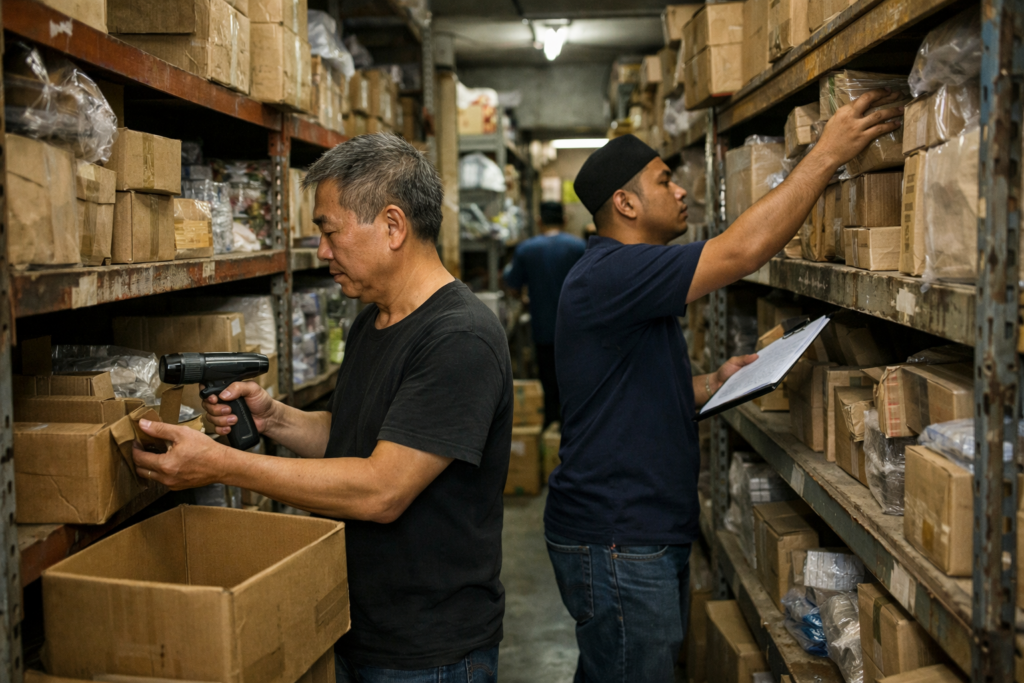
Marketplace Fragmentation and System Stress
Southeast Asia’s e-commerce landscape is highly fragmented. Platforms like Shopee, Lazada, and TikTok Shop operate with different logic, APIs, and fulfillment expectations.
This fragmentation creates invisible pressure on backend systems.
Each platform introduces its own rules for order status updates, cancellation windows, and shipping workflows. When aggregated, these differences create synchronization challenges that most systems are not designed to handle efficiently.
The issue is not integration. It is orchestration.
High Volume Marketplace Order Management requires systems that can interpret and align these differences in real time. Without this capability, businesses experience delays, mismatches, and manual corrections.
Operational noise increases with scale.
Inventory Accuracy Becomes a Systemic Risk
Inventory errors are often treated as isolated mistakes. In reality, they are systemic signals of deeper structural misalignment.
At high order volumes, even minor discrepancies can cascade across channels. A single stock miscount can trigger overselling, cancellations, and platform penalties.
This is not just a warehouse issue. It is a marketplace credibility issue.
High Volume Marketplace Order Management depends heavily on inventory synchronization accuracy. When inventory data lags behind order flow, the system begins to degrade.
Speed without accuracy is dangerous.
Businesses that scale without strengthening inventory visibility often face diminishing returns, despite increasing sales volume.
Fulfillment Bottlenecks Are Not Random
Many operations teams describe fulfillment delays as unpredictable. In reality, these bottlenecks follow identifiable patterns.
Order surges during campaigns, SKU concentration in specific categories, and uneven picking workloads all contribute to system stress. These are not random events. They are predictable outcomes of marketplace dynamics.
The problem is anticipation.
High Volume Marketplace Order Management requires forecasting not just demand, but operational strain. Systems must anticipate peak loads and adjust workflows accordingly.
Without predictive capability, businesses are always reacting.
And reaction is always slower than demand.

Cost Structures Shift at Scale
At low volumes, inefficiencies are often absorbed by margins. At high volumes, they become financially visible.
Manual interventions, error corrections, and delayed shipments introduce hidden costs that accumulate rapidly. Labor costs increase, customer support workload expands, and platform penalties begin to impact profitability.
Efficiency becomes a margin driver.
High Volume Marketplace Order Management is directly tied to cost structure optimization. Businesses that fail to streamline operations at scale often see revenue growth without proportional profit growth.
Growth without efficiency is unsustainable.
This is where many scaling businesses encounter their first operational ceiling.
System Resilience Defines Long-Term Scalability
Most systems are designed for normal conditions. Few are designed for stress.
Resilience is the ability to maintain performance under extreme load, not just during average operations. This includes handling order spikes, system failures, and data inconsistencies without cascading breakdowns.
Stability is a competitive advantage.
High Volume Marketplace Order Management requires systems that can degrade gracefully rather than fail abruptly. This includes fallback processes, redundancy, and real-time monitoring.
Without resilience, scaling introduces fragility.
And fragile systems do not scale sustainably.
Why Incremental Fixes Eventually Fail
Many businesses attempt to solve scaling challenges by layering additional tools or manpower onto existing systems.
This approach works temporarily.
However, each new layer introduces additional complexity, increasing the risk of misalignment and inefficiency. Over time, the system becomes harder to manage and more prone to failure.
Complexity compounds silently.
High Volume Marketplace Order Management cannot rely on patchwork solutions indefinitely. At a certain scale, structural redesign becomes necessary.
This is the inflection point.
Businesses must decide whether to continue optimizing around limitations or rebuild the system architecture to support long-term growth.

The Shift Toward Integrated Operational Systems
As operational complexity increases, businesses begin to move toward more integrated systems that unify inventory, order processing, and fulfillment workflows.
This shift is not about adopting new technology. It is about reducing fragmentation.
Integrated warehouse management solutions, such as PayRecon WMS, represent one pathway toward this transition. These systems are designed to centralize inventory visibility and streamline fulfillment processes across multiple sales channels.
However, adoption alone is not a solution.
The value comes from aligning system capabilities with operational realities. Businesses must evaluate whether their current workflows are compatible with integrated systems before implementation.
Technology amplifies structure.
If the underlying processes are inefficient, integration will only expose those inefficiencies more clearly.
Conclusion: Scaling Requires Structural Discipline
High Volume Marketplace Order Management is not a tool problem. It is a system design challenge.
Businesses that treat scaling as a linear process often encounter hidden constraints that limit growth. Volume introduces complexity, and complexity requires structured management.
The opportunity remains strong, but it is conditional.
Scalable operations depend on alignment between order flow, inventory accuracy, fulfillment capacity, and system resilience. Without this alignment, growth becomes increasingly unstable.
Sustainable scaling demands discipline.
In the long term, businesses must prioritize structural clarity over short-term expansion. This includes investing in systems, processes, and operational visibility that can withstand increasing complexity.
The question is no longer whether demand can grow.
It is whether the system can survive it.