Why is my warehouse staff productivity low during mega sales?
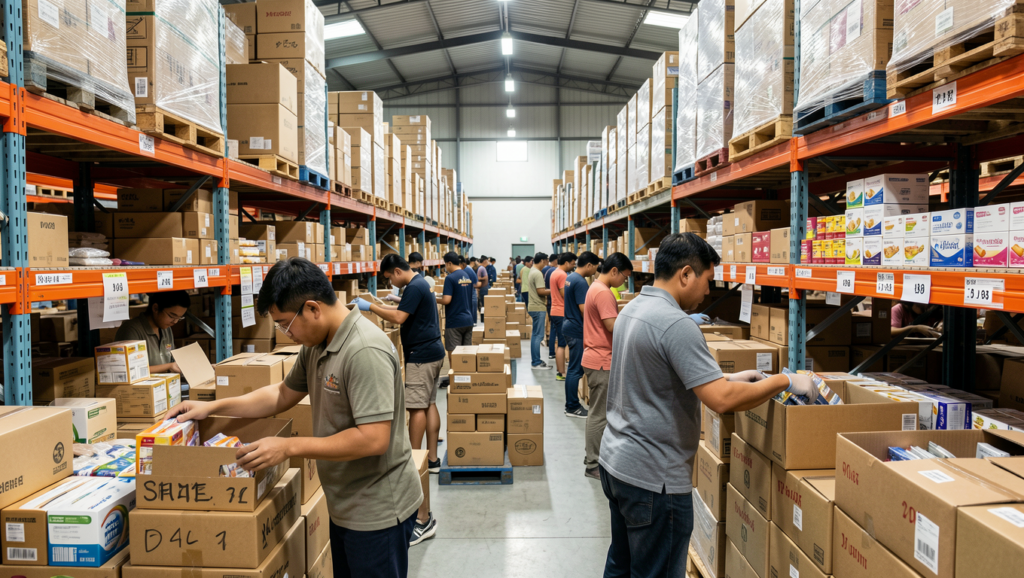
During mega sales periods, such as year-end promotions or online shopping festivals, warehouses often experience low warehouse staff productivity—even when overtime hours are added and extra staff are deployed. Pick-and-pack rates can drop by 20–40% compared to normal days, causing delayed shipments and frustrated customers.
The visible chaos—rushed workers and messy shelves—is obvious, but the deeper causes usually lie in inventory management, process design, and incentive alignment. Understanding these drivers is key to maintaining efficiency during peak demand.
Even warehouses with well-trained teams can experience low warehouse staff productivity, with pick-and-pack rates dropping by 20–40% during peak sale days. While visible chaos—messy shelves, workers rushing—is easy to notice, the deeper causes usually involve inventory management, process design, and incentive alignment.
Understanding these drivers can help businesses navigate high-volume periods with fewer errors and better staff utilization.
Quick Summary: Low Warehouse Staff Productivity
Core issue: Low warehouse staff productivity during mega sales often stems from structural constraints rather than workforce capability.
Key points:
- Low Warehouse Staff Productivity can drop 20–40% during peak sales.
- Common bottlenecks: disorganized inventory, unoptimized picking routes, poor cross-docking, and manual data entry.
- Economic incentives and operational design heavily influence efficiency.
- Technology, like purpose-built WMS solutions, can stabilize throughput and reduce stress on staff.

Inventory Complexity and Physical Bottlenecks
When mega sales strike, even small mismatches in inventory allocation become magnified. Warehouses handling thousands of SKUs may suddenly face orders concentrated on a handful of popular items. Without dynamic slotting or priority picking, staff waste time moving back and forth, leading to fatigue and slower fulfillment.
Physical layout plays a major role in low warehouse staff productivity: congested aisles, narrow picking zones, and unsegmented packing areas all compound delays. Data from Southeast Asian e-commerce logistics shows warehouses without systematic slotting often see order picking speeds fall 30% during sales spikes.
Process Design and Task Allocation
Many warehouses still rely on static workflows designed for average daily demand, so it cause low warehouse staff productivity. During mega sales, this rigidity fails:
- Manual batching: Orders are often grouped without considering location or size, increasing travel time.
- Inflexible roles: Staff assigned to single tasks (picking, packing, or labeling) cannot adapt when demand surges in one zone.
- Paper-based or spreadsheet tracking: Human error rises sharply, forcing repeated corrections.
Structuring processes around dynamic demand, with clear cross-training and adaptive batching, can maintain higher throughput.

Economic and Incentive Structures
Staff behavior during high-pressure periods significantly affects low warehouse staff productivity. Flat daily wages or fixed overtime pay may not motivate speed or accuracy under stress. Conversely, commission-based or piece-rate incentives can increase speed but also raise error rates if not balanced with quality checks.
Platform-driven e-commerce models exacerbate low warehouse staff productivity. Tight delivery windows, high seller penalties for late fulfillment, and customer expectations create misaligned incentives, leaving staff caught between speed and accuracy.
Technological Leverage: WMS Integration
As operational complexity rises, purpose-built warehouse management systems (WMS) become crucial. Tools like PayRecon WMS offer dynamic order routing, real-time inventory visibility, and automated batching—all designed to reduce human error and optimize staff movement.
Integrating a WMS allows warehouses to:
- Pre-prioritize high-volume SKUs.
- Adjust picking sequences in real time.
- Monitor Low Warehouse Staff Productivity with actionable dashboards.
While WMS adoption requires upfront investment and training, the operational resilience during mega sales often justifies the cost, especially for SMEs scaling across multiple platforms.

Realistic Outcome Scenarios
Even with optimized layouts, dynamic processes, and WMS support, productivity gains have natural limits:
- Moderate complexity warehouses: Can reduce peak-day delays by 15–25%.
- High SKU and multi-channel warehouses: Gains may plateau without continuous staff training and system tuning.
- Behavioral factors: Staff fatigue and misaligned incentives remain constraints; technology alone cannot fully replace management oversight.
Conclusion for Low Warehouse Staff Productivity
Low warehouse staff productivity during mega sales is rarely a question of effort alone—it is a structural and economic challenge. Businesses can mitigate the drop through adaptive process design, incentive alignment, and strategic technology integration like PayRecon WMS. However, gains are often bounded by layout, SKU complexity, and staff behavior. Recognizing these limits allows managers to make informed investments and set realistic operational expectations, ensuring that mega sales growth translates into actual revenue rather than logistical headaches.