Warehouse Control Issues That Disrupt Operations
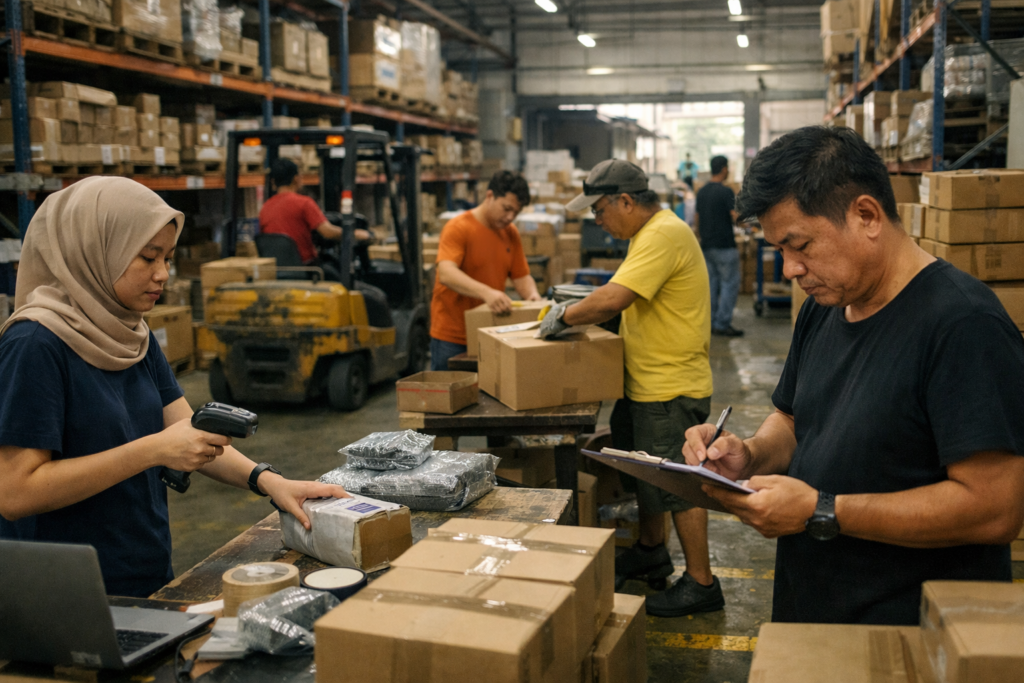
Warehouse control issues rarely appear as a single failure point. They emerge quietly through delays, mismatched data, and rising operational friction. Most businesses only react when losses become visible. This article explains the underlying mechanisms behind warehouse control issues and why they persist despite system investments.
Introduction
Warehouse operations are under increasing pressure across Southeast Asia, especially as eCommerce and omnichannel fulfillment accelerate. Businesses expect systems to create order, yet many still struggle with execution gaps. The assumption is simple: implement software, and control improves.
That assumption is flawed.
Warehouse control issues are not purely technological problems. They are structural misalignments between processes, data flows, and operational behavior. Many organizations focus on tools while ignoring control logic. As a result, inefficiencies persist even in digitally enabled environments.
Beginner-level advice often focuses on features, dashboards, or automation. These elements matter, but they do not address control integrity. This article takes a different lens. It analyzes the mechanisms that create control failures and explains why they continue to disrupt operations at scale.
Warehouse Control Issues Begin with Process Fragmentation
Most warehouse environments evolve in layers rather than through deliberate design. New processes are added to solve immediate problems, but rarely integrated into a unified control structure.
Over time, fragmentation becomes normalized.
Each operational function operates with its own logic. Picking, packing, inventory updates, and returns may follow different workflows. These workflows often lack synchronization, leading to inconsistent execution.
The issue is not inefficiency alone. It is misalignment.
When processes are fragmented, control becomes reactive rather than predictive. Teams rely on manual checks instead of system-driven validation. Errors are detected late, often after they impact customers or financial records.
Control fails when processes stop communicating.
Data Inconsistency Is a Symptom, Not the Root Cause
Inventory discrepancies are often treated as isolated data errors. Businesses respond with stock counts, reconciliation efforts, or stricter SOPs. While these actions may reduce visible errors, they do not address the underlying cause.
Data inconsistency reflects deeper control weaknesses.
When warehouse control issues exist, data flows become unreliable. Transactions are recorded at different times across systems. Manual inputs introduce variation. Integration gaps delay updates between platforms.
The result is a distorted operational picture.
Decision-makers rely on data that does not reflect real-time conditions. This creates a feedback loop where incorrect data drives incorrect actions. Over time, trust in the system erodes, and teams revert to manual tracking.
Manual control is not scalable.
The Illusion of System Control Without Execution Discipline
Many businesses assume that implementing a Warehouse Management System (WMS) guarantees operational control. This belief overlooks a critical factor: execution discipline.
Systems enforce logic. People execute it.
Without consistent adherence to process rules, even the most advanced systems lose effectiveness. For example, barcode scanning may exist, but staff bypass it during peak periods. Inventory updates may be required, but delayed due to workload pressure.
This creates a gap between system design and real-world behavior.
Warehouse control issues often emerge in this gap. The system reflects an ideal state, while operations follow a different reality. Over time, the divergence widens, and control deteriorates.
Technology cannot compensate for inconsistent execution.
Operational Complexity Amplifies Control Failures
As businesses scale, warehouse operations become more complex. Multiple sales channels, higher SKU counts, and faster fulfillment expectations increase the pressure on control systems.
Complexity introduces new failure points.
Each additional channel adds integration requirements. Each new product increases tracking complexity. Each operational expansion creates more dependencies between processes.
Without a strong control framework, these dependencies break down.
Warehouse control issues become more frequent and harder to diagnose. Errors are no longer isolated. They cascade across systems, affecting inventory accuracy, order fulfillment, and financial reporting simultaneously.
Scale without control leads to instability.
Control Gaps Create Hidden Financial Leakage
Warehouse control issues are often evaluated through operational metrics such as picking speed or order accuracy. However, their financial impact is frequently underestimated.
The real cost is cumulative.
Small discrepancies in inventory lead to stockouts or overstocking. Delayed updates affect cash flow visibility. Incorrect fulfillment increases return rates and operational costs.
These effects compound over time.
In Southeast Asian markets, where margins can be tight, even minor inefficiencies translate into significant losses. Businesses may not attribute these losses directly to warehouse control issues, but the connection is structural.
Leakage rarely appears as a single line item.
Why Traditional Fixes Fail to Resolve Warehouse Control Issues
Organizations often respond to control problems with incremental fixes. They introduce additional checks, increase manpower, or implement new tools. While these actions may provide temporary relief, they do not resolve the core issue.
They treat symptoms, not systems.
Adding more manual checks increases workload without improving control logic. Hiring more staff may reduce pressure temporarily but introduces new coordination challenges. Implementing tools without redesigning processes creates further fragmentation.
Control requires structural alignment.
Without rethinking how processes, data, and systems interact, warehouse control issues persist. The problem shifts location but does not disappear.
Rebuilding Control Through System-Process Alignment
Sustainable control emerges when systems and processes are designed together. This requires a shift from reactive problem-solving to proactive structure building.
Control must be intentional.
However, businesses need to define clear operational logic. Each process should align with system capabilities, and each system should enforce process rules. Data flows must be synchronized to ensure real-time accuracy.
This alignment reduces ambiguity.
At this stage, purpose-built solutions such as PayRecon WMS may become relevant. Not as a quick fix, but as part of a broader structural upgrade. When operational complexity reaches a certain threshold, generic tools often lack the depth required for control integrity.
Specialization supports scalability.
However, technology alone is not sufficient. Organizations must also invest in training, process discipline, and continuous monitoring. Control is maintained through consistency, not configuration.
Conclusion: Control Is a Structural Commitment, Not a Feature
Warehouse control issues are not temporary disruptions. They reflect deeper structural weaknesses within operations. Addressing them requires more than tools or short-term fixes.
Control is a long-term commitment.
Businesses that treat control as a system feature will continue facing recurring issues. Those that approach it as a structural discipline can achieve sustainable operational stability.
The opportunity is real but conditional.
For growing businesses in Malaysia and Southeast Asia, the path forward lies in aligning processes, data, and systems into a cohesive framework. This may involve adopting more advanced solutions when necessary, but only as part of a broader strategy.
Focus on structure first.
Because in warehouse operations, control is not something you install. It is something you build.