Stockouts and Overselling Explained
Stockouts and overselling expose critical inventory stockout issues and overselling problems that stem from structural gaps in visibility, integration, and warehouse workflows.

Introduction
When businesses confront stockouts and overselling, they’re facing symptomatic failures of their broader inventory and warehouse ecosystems. Stockouts — situations where demand cannot be met due to unavailable inventory — and overselling — commitments made against inventory that doesn’t exist — degrade customer trust and disrupt revenue continuity. The former compounds lost sales, while the latter damages brand credibility when orders must be canceled or delayed. Both are not simply tactical issues but are architectural in nature, often reflecting fragmented data streams, asynchronous systems, and workflow bottlenecks that emerge as companies scale. In complex environments where multichannel sales intersect with distributed warehouses, these problems are magnified without strategic alignment between systems, processes, and organizational maturity levels. Understanding the structural causes of stockouts and overselling is therefore essential to designing resilient operations that can sustain growth without sacrificing performance or reliability.
Why Stockouts and Overselling Happen
Stockouts and overselling are closely related yet distinct manifestations of inventory system limitations. A stockout occurs when actual on‑hand inventory is zero or below customer demand thresholds, causing immediate lost sales and service failures. According to standard inventory definitions, stockouts happen when the inventory is depleted prior to fulfillment, and customers either backorder or abandon purchases altogether. 【Resources Links】
Conversely, overselling reflects a systemic disconnect: sales channels commit inventory that isn’t truly available. This often arises when systems fail to synchronize real‑time stock levels across marketplaces, retail points of sale, and warehouse records. Because of this, order promises are made against phantom inventory, subsequently forcing cancellations or fulfillment delays. In many cases, overselling stems from delayed inventory updates, either due to batching or architectural latency, rather than deliberate policy choices. 【Resources Links】
Thus, at root, both phenomena reveal visibility gaps. Stockouts are the visible result when supply fails to meet demand; overselling is the by‑product of delayed or inconsistent inventory visibility across interconnected systems.
Architectural Trade-Offs That Drive Inventory Limitations
When businesses evaluate inventory and warehouse systems, the fundamental trade‑off is between operational visibility and velocity, and the complexity and cost of achieving that visibility in real time.
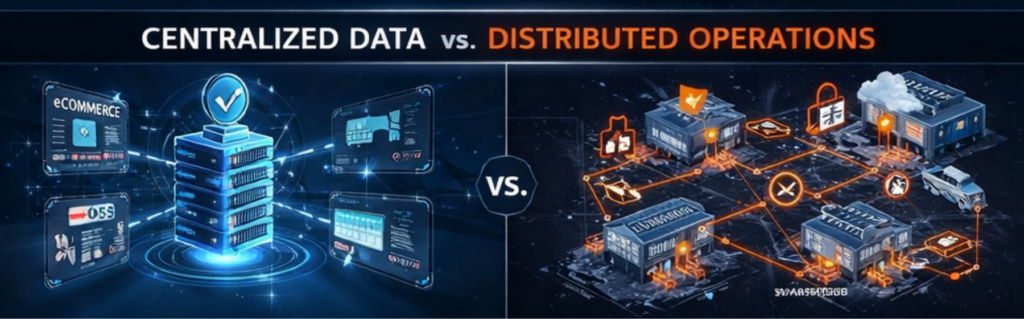
Centralized Data vs. Distributed Operations
Centralized inventory models aim to maintain a single source of truth for stock levels. While this reduces disparities between sales channels, it also requires robust infrastructure and synchronization mechanisms to ensure that updates propagate instantaneously.
Distributed warehouse networks improve fulfillment speed by positioning inventory closer to customer demand, yet they exacerbate synchronization challenges, as multiple endpoints must continuously reconcile stock levels.

Real-Time Synchronization vs. Batch Updates
Real‑time integration reduces both overselling and stockouts by ensuring that every transaction immediately updates inventory data, preventing inconsistent stock counts across channels. According to industry analyses of modern Warehouse Management Systems (WMS), real‑time visibility is one of the key advantages of adoption, precisely because it minimizes stockouts and overselling while improving order accuracy. 【Resources Links】
However, real‑time systems demand higher operational costs, stronger network reliability, and more sophisticated APIs. For many SMEs on legacy ERPs or spreadsheet‑based systems, such integration remains aspirational, not tactical.
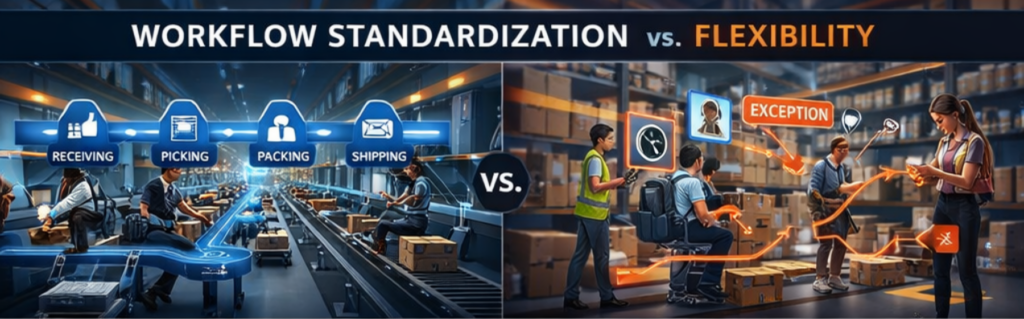
Workflow Standardization vs. Flexibility
Rigid, standardized workflows enforce tight inventory controls and ensure predictable, auditable operations. However, this rigidity can hinder rapid response during peak demand or sudden supply shifts.
Flexible workflows enable exception handling but increase variance in data capture and delay stock level reconciliation, thus heightening the risk of overselling or inaccurate demand fulfillment.
Professionals evaluating these trade‑offs should not only consider immediate operational needs but also how architectural choices embed long‑term constraints on scalability and trust.
How Poor Inventory Management Causes Stockouts

Poor inventory management is a common vector for inventory stockout issues, especially when systems lack accurate real‑time insight into inventory positions. Without this visibility, companies cannot proactively respond to demand fluctuations or supply delays.
When sales and warehouse systems operate in silos, teams often accept orders without properly verifying actual stock levels. This gap leads directly to overselling and eventually triggers stockouts.
Fragmented inventory data also delays the detection of low-stock conditions. As a result, teams miss critical opportunities to replenish inventory before depletion — a common issue in legacy or manual environments.
Moreover, reliance on periodic inventory counts rather than continuous monitoring increases the risk of out‑of‑date stock views, which becomes amplified as SKU complexity grows.
Crucially, stockout episodes are more than occasional disruptions — they can signal systemic misalignment between demand projections, lead‑time assumptions, and actual inventory flow. The cumulative effect is not only revenue leakage but also eroded customer loyalty over repeated failures.
Stockouts vs Overselling: Warehouse Perspective
From a warehouse operations standpoint, the difference between stockouts and overselling lies in visibility and control points within the fulfillment lifecycle.
Stockouts are most acutely felt at the moment of picking or allocation, where inventory is expected but unavailable. Delays in detection frequently arise because warehouse systems lack real‑time updates, meaning that orders continue to be promised even as stock depletes.
Overselling often emerges earlier, at the point of order entry. When sales channels fail to obtain instant confirmation of inventory availability — due either to technological latency or disparate systems — overselling is the inevitable consequence.
Both of these metrics are therefore dependent on the warehouse’s ability to provide accurate, accessible inventory information:
Warehouse Management Systems that offer real‑time inventory visibility reduce discrepancies between recorded stock levels and actual availability. 【Resources Links】
Systems without such capabilities, or with delayed data reconciliation, inherently propagate inconsistencies that manifest as overselling or stockouts.
The structural challenge lies not in isolated components but in how tightly inventory controls, visibility, and cross‑system communication are integrated.
Operational Visibility and System Maturity
As operations scale, the demand for visibility and automated control becomes strategic rather than operational. Mature systems mitigate overselling problems by:
Prioritizing real‑time inventory reconciliation across channels.
Supporting automated alerts for impending stockouts, enabling proactive replenishment.
Consolidating sales, warehouse, and fulfillment data streams for analytical insight.
Indeed, numerous industry sources identify real‑time synchronization and visibility as foundational to reducing operational inefficiencies, fulfilling orders accurately, and maintaining customer trust.
However, SMEs often delay investing in such capabilities due to cost concerns or resource constraints, only to confront compounded operational friction as order complexity grows. The strategic inflection point typically arrives when manual workflows, spreadsheets, and legacy ERPs no longer suffice to manage multichannel volume without increasing error rates.
Where PayRecon WMS Fits into the Operational Evolution
It’s at this juncture — when businesses outgrow basic systems — that purpose‑built solutions like PayRecon WMS become relevant. Rather than positioning them as the sole answer, it is more accurate to view them as part of a broader trajectory toward operational maturity. A sophisticated WMS:
Centralizes inventory data across disparate channels and locations, reducing the latency that contributes to overselling and stockouts.
Standardizes workflows, enforces data capture discipline, and supports automated replenishment triggers.
Provides analytical visibility that strengthens forecasting and demand planning.
Platforms such as these are therefore not merely tactical tools but strategic enablers for businesses moving from reactive inventory control to proactive operational design.
Conclusion
Stockouts and overselling are systemic symptoms of deeper architectural and operational misalignments. They are not isolated events but the outcome of delayed visibility, asynchronous systems, and fragmented workflows. Businesses typically outgrow basic spreadsheet‑based or ERP inventory tracking once order velocity, multichannel complexity, and SKU proliferation render manual synchronization untenable.
At this stage, advanced warehouse management platforms — including PayRecon WMS — represent a natural progression toward integrated visibility, workflow control, and analytical insight. These solutions help bridge the structural gaps that otherwise perpetuate inventory stockout issues and overselling problems, enabling organizations to scale without sacrificing performance.
For decision‑makers, the strategic imperative is to balance short‑term operational realities with long‑term architectural investments, recognizing that visibility, integration, and standardized workflows are foundational to resilient, growth‑oriented inventory systems.