SQL Stock Management Capabilities Explained for Growing Businesses

SQL Stock Management remains widely used for inventory operations, yet increasing warehouse complexity often challenges its architecture, prompting businesses to evaluate operational visibility, workflow control, and long-term system scalability.
Introduction
For many small and mid-sized businesses, SQL Stock Management represents an early step toward digitizing inventory operations. Because SQL-based systems typically integrate with accounting platforms and simple inventory modules, they often become the operational backbone for tracking products, monitoring stock levels, and generating reports. However, as businesses expand product lines, sales channels, and warehouse operations, the limitations of a traditional database-driven inventory framework become more visible.
At first glance, the core promise of SQL-based inventory infrastructure appears straightforward: structured data, transactional reliability, and centralized control. Yet the reality of modern logistics environments is far more complex. Multi-channel commerce, distributed fulfillment models, and real-time operational visibility requirements place increasing pressure on legacy SQL Stock Management frameworks. Consequently, businesses must evaluate not only system functionality but also architectural scalability, operational maturity, and workflow adaptability.
Understanding where SQL-driven inventory systems fit within the broader technology landscape therefore requires strategic analysis rather than surface-level feature comparison.
Understanding SQL Stock Management in the Inventory Technology Landscape
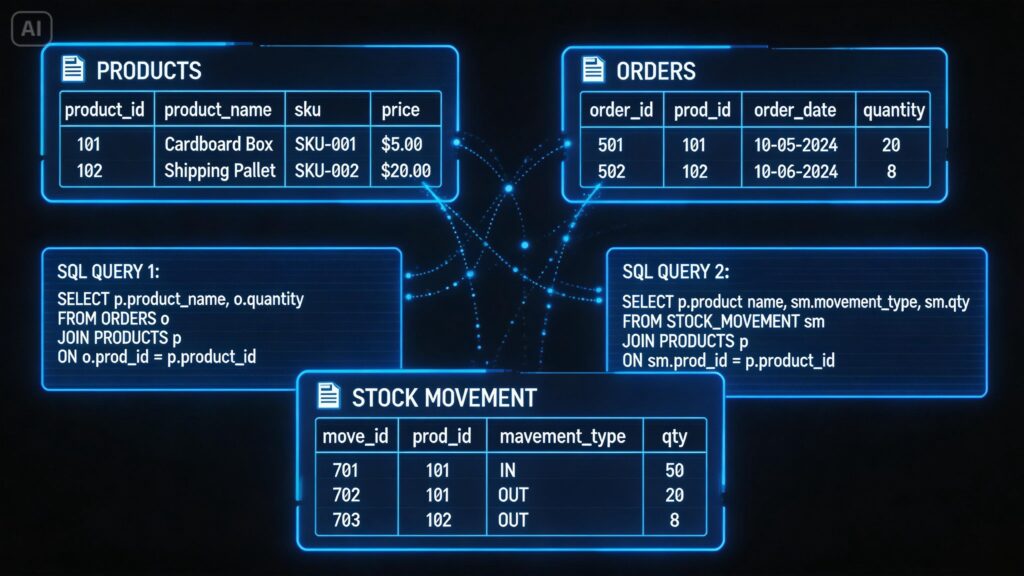
At its core, SQL Stock Management refers to inventory control systems built on structured relational databases using Structured Query Language (SQL). These systems rely on relational tables to track product records, transaction logs, stock movement history, and reporting outputs.
Because SQL databases prioritize consistency and structured data integrity, they are well suited to traditional inventory control environments where transactions occur in predictable workflows.
Relational database structure
Transactional consistency (ACID properties)
Structured query operations for reporting
For readers interested in the theoretical foundation, the concept of relational databases originates from Edgar F. Codd’s work on the Relational Model of Data, which established the principles behind modern SQL systems. 【Resources Links】
However, while relational databases provide reliability, they also impose structural rigidity. As operational environments evolve, this rigidity can influence how inventory processes scale.
In practical terms, SQL Stock Management systems commonly support three operational functions:
| Function | Operational Purpose |
|---|---|
|
Stock tracking |
Monitoring inventory quantities across locations |
|
Inventory control |
Managing adjustments, transfers, and replenishment |
|
Stock reporting |
Generating structured reports for finance and operations |
These capabilities explain why SQL-based systems remain prevalent among SMEs transitioning from spreadsheets toward structured digital infrastructure.
How Businesses Evaluate SQL Stock Management Systems

When organizations assess SQL Stock Management, their evaluation rarely focuses solely on feature lists. Instead, decision makers typically consider how well the system aligns with operational scale and workflow complexity.
Several evaluation dimensions often emerge.
SQL-based inventory systems emphasize structured relational data models. As a result:
Strengths
High data integrity
Predictable reporting structures
Clear audit trails for transaction history
These characteristics make SQL systems particularly attractive for accounting-linked inventory environments.
However, the same design also introduces constraints.
Limitations
Limited flexibility for dynamic warehouse workflows
Difficulty modeling complex fulfillment scenarios
Heavy reliance on manual operational coordination
For example, in a typical SME wholesale operation, stock tracking may initially involve only inbound purchase orders and outbound sales orders. However, once businesses add multiple warehouses, pick-and-pack workflows, or e-commerce integrations, operational complexity expands faster than database structures evolve.
Another defining trait of SQL Stock Management is its emphasis on structured stock reporting.
Because SQL databases excel at query-based reporting, businesses often benefit from:
Detailed historical inventory reports
Financial reconciliation support
Traceable inventory adjustments
Nevertheless, reporting-centric systems sometimes struggle to provide real-time operational visibility.
Academic research on database performance illustrates how transactional systems prioritize consistency over real-time responsiveness in high-volume environments.
Consequently, while SQL reporting remains powerful, warehouse operations increasingly demand:
live picking status
real-time inventory availability
operational workflow monitoring
These requirements extend beyond traditional database reporting.
Integration capability often becomes a decisive factor when evaluating SQL Stock Management.
Because SQL databases can connect to external systems via APIs or middleware, they frequently integrate with:
accounting platforms
ERP systems
e-commerce marketplaces
However, integration alone does not guarantee operational synchronization.
For instance, if an online order triggers a stock deduction in the database, but warehouse picking occurs hours later, data accuracy may temporarily diverge from physical inventory reality.
In such cases, inventory control becomes partially dependent on manual processes rather than system-enforced workflows.
Scalability Challenges in Growing Warehouse Environments

As businesses expand operations, the architectural boundaries of SQL Stock Management become more pronounced. These challenges typically emerge in three areas.
Operational Workflow Complexity
Modern warehouses increasingly rely on structured workflows:
batch picking
wave picking
barcode scanning
real-time task allocation
Traditional SQL-based inventory modules often lack native support for these operational mechanisms.
Instead, they function primarily as data repositories rather than workflow engines.
Research on warehouse automation highlights how operational efficiency depends heavily on workflow orchestration rather than database storage alone.
Therefore, while SQL databases remain essential infrastructure, they rarely serve as the sole operational layer for complex warehouses.
Multi-Channel Commerce Pressure
E-commerce growth has introduced additional complexity into stock tracking.
Businesses frequently sell products across multiple channels simultaneously:
online marketplaces
direct webstores
wholesale distributors
physical retail outlets
Each channel generates inventory transactions that must remain synchronized.
Although SQL Stock Management systems can technically store these transactions, coordinating real-time stock availability across channels becomes increasingly difficult without specialized operational logic.
Data Synchronization Across Physical Operations
One of the most common scaling issues involves the gap between digital records and physical warehouse activities.
Consider a typical scenario in Southeast Asian SMEs:
Orders arrive from multiple marketplaces.
Inventory deducts automatically in the system.
Warehouse staff manually pick products from shelves.
Shipment confirmation occurs later.
During this window, digital inventory control records may diverge from actual stock levels.
As warehouse activity intensifies, maintaining synchronization requires additional operational tooling beyond standard SQL inventory modules.
The Role of Warehouse Management Platforms in System Evolution

For many organizations, SQL Stock Management remains an important foundational layer rather than a complete operational solution. As warehouse complexity increases, businesses often supplement database-driven inventory systems with purpose-built warehouse management platforms.
These systems introduce capabilities that extend beyond traditional inventory databases:
warehouse workflow orchestration
real-time task management
barcode-driven picking operations
operational visibility dashboards
In this context, warehouse management platforms function as an operational layer sitting above the underlying data infrastructure.
Solutions such as PayRecon WMS, for example, represent one category of specialized warehouse management systems designed to coordinate inventory movement, operational workflows, and multi-channel fulfillment processes. Rather than replacing database-driven inventory systems outright, such platforms often integrate with them while managing warehouse execution logic.
This architectural separation reflects a broader industry trend: databases maintain transactional records, while warehouse management systems govern operational workflows.
Strategic Positioning of SQL Stock Management in Business Growth Stages
To understand the long-term relevance of SQL Stock Management, it is helpful to examine how system requirements evolve across business maturity stages.
| Business Stage | Operational Characteristics | Role of SQL Stock Management |
|---|---|---|
|
Early SME stage |
Limited SKUs, simple order flow |
Core inventory database |
|
Growth stage |
Multiple channels, higher order volume |
Reporting and accounting integration |
|
Operational scaling |
Warehouse workflows, multi-location operations |
Foundational data layer |
|
Advanced logistics |
Automation, workflow orchestration |
Integrated infrastructure component |
At earlier stages, SQL-based inventory infrastructure provides sufficient stock reporting and stock tracking capability.
However, as operational complexity grows, businesses increasingly require systems capable of orchestrating warehouse activity rather than merely recording transactions.
Conclusion
SQL Stock Management continues to play a critical role in inventory infrastructure for many SMEs. Its strengths—structured data integrity, reliable reporting capabilities, and integration with financial systems—make it a practical foundation for early-stage digital inventory management.
However, as businesses scale operations, the architectural trade-offs of SQL-driven inventory systems become more visible. While these systems excel at inventory control and historical stock reporting, they are not inherently designed to manage dynamic warehouse workflows, multi-channel synchronization, or real-time operational visibility.
Consequently, organizations often reach a stage where traditional inventory databases remain necessary but no longer sufficient. At this point, operational evolution typically involves introducing specialized warehouse management platforms that coordinate physical logistics activity while maintaining integration with underlying inventory databases.
Warehouse management solutions such as PayRecon WMS represent one pathway within this broader technological progression. Rather than replacing SQL infrastructure entirely, these systems complement it by managing the operational complexity that emerges as businesses grow.
Ultimately, the strategic question for businesses is not whether SQL Stock Management remains useful—it often does. The more important consideration is recognizing when operational scale requires additional systems designed specifically for warehouse execution and logistics coordination.