SQL Inventory Module Explained for SMEs
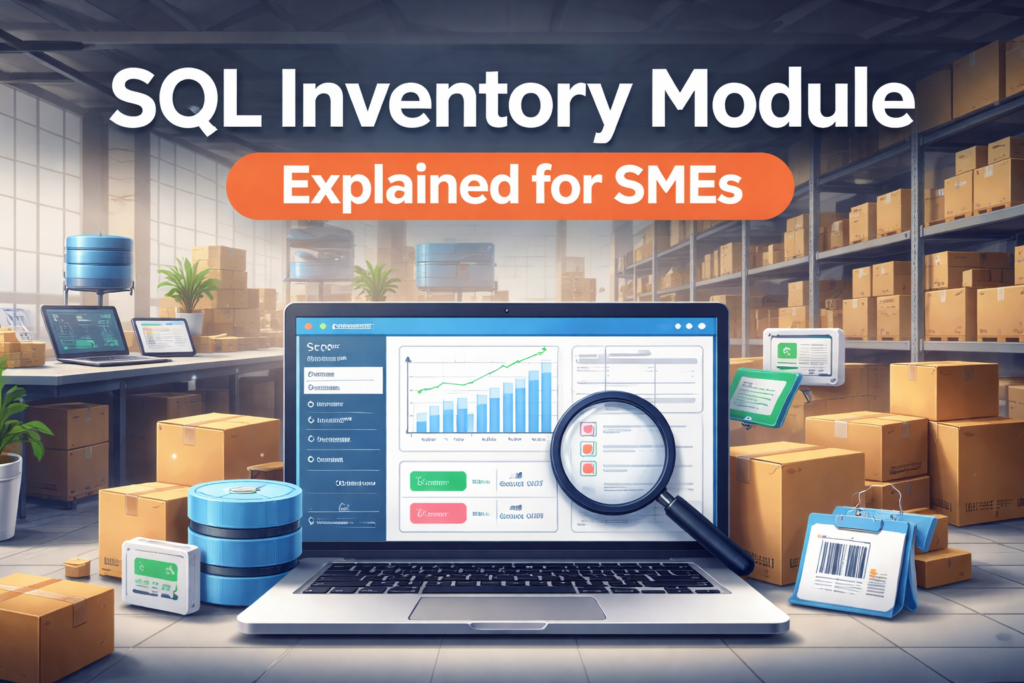
The SQL inventory module supports inventory setup, stock in stock out tracking, and reporting; however, its architectural simplicity constrains scalability for growing SMEs seeking advanced operational visibility.
Introduction
Within the landscape of enterprise resource planning and inventory control, the SQL inventory module represents a foundational yet limited system category. Predominantly built around relational database structures, these modules excel in managing essential inventory setup, basic stock in stock out workflows, and generating straightforward inventory reporting. For SMEs operating with relatively linear product flows, such systems provide accessible operational oversight without requiring extensive IT infrastructure.
However, as businesses scale—especially in dynamic Southeast Asian markets—SQL inventory modules begin to reveal constraints in workflow complexity, multi-location synchronization, and real-time visibility. Consequently, understanding both their capabilities and limitations becomes critical for strategic decision-making. Furthermore, organizations evaluating operational software must consider not only immediate functionality but also long-term adaptability.
Therefore, this analysis explores the structural strengths, inherent trade-offs, and strategic limitations of SQL inventory modules. In addition, it helps business leaders evaluate where such systems fit within their growth trajectory and what operational considerations emerge when transitioning to more specialized solutions.
Understanding the SQL Inventory Module
The SQL inventory module is, at its core, a relational database-driven inventory management approach. More specifically, it is designed to standardize core stock handling processes while maintaining a simple architecture grounded in the relational model of data (relational model basics). As a result, the system emphasizes structured data consistency and predictable transactional workflows.
Key functionalities include:
Inventory Setup
Defining SKUs, units of measure, stock categories, and basic reorder thresholds.
Stock In Stock Out
Recording incoming and outgoing inventory transactions with date‑stamped logs.
Inventory Reporting
Producing summary reports such as stock balances, movement histories, and basic trend analysis.
Strategic Positioning:
SQL inventory modules excel in environments where inventory complexity is moderate and operational processes are relatively linear. In particular, SMEs with centralized warehouse operations often find these systems adequate for early-stage inventory control. However, the simplicity of a relational database ensures data integrity and transactional reliability. At the same time, this same simplicity limits dynamic adaptability as operations scale. Therefore, the architectural trade-off becomes more visible as businesses expand their operational scope.
Key Structural Strengths:

Relational integrity reduces discrepancies in stock counts. Consequently, businesses can maintain accurate transactional histories with relatively low technical complexity.

Minimal configuration allows SMEs to implement inventory tracking rapidly. Moreover, organizations without extensive IT resources can adopt such systems without significant infrastructure investment.

These systems operate efficiently on modest database environments. As a result, they are suitable for companies without specialized IT teams or advanced server environments.
Limitations:
Despite these advantages, several structural limitations emerge as operational complexity increases.

Standardized processes cannot easily model advanced pick-pack-ship workflows. For instance, dynamic picking strategies or automated allocation logic often require additional system layers.

Synchronization across warehouses typically requires manual or semi-automated interventions. Consequently, maintaining accurate cross-location inventory visibility becomes increasingly difficult.

Reporting is often batch-oriented rather than real-time. Therefore, operational managers may experience delays when responding to inventory fluctuations or fulfillment issues.
For reference, several GitHub projects illustrate basic SQL inventory systems and their relational design principles (example project). In practice, these examples highlight both the strengths and structural constraints of database-driven inventory designs.
Architectural and Scalability Trade‑Offs
SQL inventory modules prioritize simplicity over flexibility. Therefore, their architecture, while reliable for small-scale operations, introduces several trade-offs that become apparent under growth pressures:
Relational tables handle increased transaction volumes well to a point. However, as SKUs multiply and cross-location operations expand, query performance can degrade, affecting both reporting and transactional throughput.
Most SQL inventory systems rely on periodic batch queries rather than event-driven updates. As a result, real-time visibility is limited, which can delay decision-making in fast-moving operations (Hopstack WMS challenges).
Multi-channel sales and e-commerce integrations create synchronization challenges. Consequently, delays in stock reconciliation can propagate errors across platforms, affecting fulfillment reliability.
Standard SQL modules support sequential stock operations. In contrast, advanced workflows such as batch picking, dynamic replenishment, or automated allocation rules cannot be accommodated natively.
Evaluating Business Fit
SMEs often adopt SQL inventory modules as a first-step digital inventory solution. Similarly, evaluation typically balances immediate operational simplicity against anticipated growth requirements:
|
Factor
|
Suitable SME Scenario
|
Limitation / Risk
|
|---|---|---|
|
SKU Complexity
|
<2,000 SKUs, limited variations
|
Hard to manage bundles, kits, or multi‑attribute products
|
|
Location Footprint
|
Single warehouse or centralized stock
|
Scaling to multiple warehouses introduces manual reconciliation
|
|
Transaction Volume
|
Moderate daily stock movements
|
High‑volume operations risk query lag and delayed reporting
|
|
Integration Needs
|
Minimal or internal reporting
|
Multi‑channel or ERP integration is cumbersome
|
|
Reporting Requirements
|
Periodic stock summaries
|
Advanced analytics or real‑time dashboards are unsupported
|
Contextual Insight for Southeast Asia:
In Malaysia and broader SEA markets, SMEs frequently handle multi-platform e-commerce fulfillment and cross-border distribution. However, SQL inventory modules meet basic reporting needs but struggle with complex logistics such as batch tracking for consumables or conditional replenishment for fast-moving SKUs.
Sub‑Keyphrase Integration: Inventory Setup, Stock In Stock Out, Inventory Reporting
The relational schema allows SMEs to define products and categories efficiently. However, advanced configurations—like multi-unit conversions, lot tracking, or serialized SKUs—require custom tables or manual workarounds.
Transaction logging ensures basic accountability but does not enforce dynamic validations, such as first-expiration-first-out (FEFO) or conditional allocation based on multiple locations. Therefore, operational risk increases as complexity grows.
SQL inventory reporting is generally snapshot-based. Consequently, it lacks the granular, real-time operational insights necessary for tactical decision-making, especially under omni-channel fulfillment demands.
Strategic Limitations and Long‑Term Considerations
While the SQL inventory module is functionally sufficient for early‑stage SMEs, long‑term digital maturity often necessitates moving beyond relational simplicity:
Connecting SQL modules to external platforms, such as marketplace APIs or logistics partners, requires significant custom development. Moreover, these integrations often introduce maintenance overhead over time. Consequently, technical dependencies can accumulate as systems evolve.
As product counts and transactional volume increase, reliance on manual stock reconciliation and periodic reporting introduces error risk. As a result, growth can become constrained by operational inefficiencies rather than market demand.
Sophisticated operational models—including dynamic allocation, automated replenishment, and multi-channel fulfillment—cannot be accommodated natively. In contrast, modern warehouse platforms are designed specifically to manage such operational complexity.
Therefore, purpose-built warehouse management platforms become increasingly relevant. Research on WMS technologies underscores benefits in real-time transaction tracking, cross-location data consistency, and end-to-end operational visibility (IJRASET WMS analysis). Similarly, studies emphasize the importance of standardized workflows across multiple sites to maintain performance at scale (JQST research).
Strategic Upgrade Path
A pragmatic progression for SMEs:
Deploy SQL inventory modules for core stock tracking and reporting to establish foundational discipline.
Evaluate pain points in stock in stock out processes, reporting latency, and integration gaps. Begin planning for incremental automation or middleware layers.
Transition to warehouse management solutions such as PayRecon WMS when complexity, SKU proliferation, or multi-channel fulfillment demands exceed the architectural limits of SQL inventory modules. Thus, businesses achieve scalable, real-time operational control (Hopstack WMS challenges).
Warehouse management evaluations consistently highlight the need for integrated, real‑time inventory control systems when multi‑location operations and high transactional velocity become business norms.
Conclusion
The SQL inventory module serves as a foundational category within the broader inventory management landscape. Its relational architecture and simplicity suit early-stage SMEs with moderate SKU complexity, centralized operations, and minimal integration needs. Nevertheless, architectural rigidity, limited real-time visibility, and synchronization constraints ultimately define a strategic ceiling for this system class.
As operational complexity grows, organizations often require more sophisticated infrastructure. Multi-channel sales environments, distributed warehouses, and real-time fulfillment expectations introduce demands that exceed the capabilities of traditional SQL-centric modules. Consequently, SMEs frequently outgrow these systems as operational maturity increases.
At this stage, purpose-built warehouse management platforms such as PayRecon WMS may become relevant evaluation options within the broader technology landscape. Rather than competing directly with SQL inventory modules, such systems extend functionality into real-time visibility, dynamic workflows, and enterprise-scale data synchronization that relational systems cannot natively provide.
Ultimately, transitioning thoughtfully allows SMEs to build operational discipline with SQL modules while preparing their infrastructure for scalable growth and more advanced warehouse management capabilities.