SQL Inventory Management Software Review

This analysis examines how SQL Inventory Management Software supports accounting-centric inventory structures while highlighting architectural trade-offs, operational limitations, and the conditions under which companies transition toward specialized warehouse systems.
Introduction
For many small and mid-sized businesses, SQL Inventory Management Software represents a pragmatic starting point for digital inventory control. Typically embedded within accounting platforms or financial management systems, these tools manage stock quantities, transaction records, and financial reconciliation within a centralized database environment. As a result, they provide strong financial visibility while maintaining relatively simple operational workflows.
However, the role of SQL Inventory Management Software becomes more complex when companies scale operations or introduce high-velocity logistics processes. Inventory ceases to function merely as a financial ledger and instead becomes an operational system requiring real-time visibility, workflow orchestration, and advanced warehouse execution capabilities.
Therefore, evaluating SQL Inventory Management Software requires more than understanding its features. Businesses must instead examine architectural priorities, integration boundaries, and long-term operational maturity. This article explores how organizations assess these systems, the structural trade-offs they encounter, and how inventory technology evolves as operational complexity increases.
Understanding the Role of SQL Inventory Management Software
At its core, SQL Inventory Management Software is built on relational database architecture designed primarily to support accounting data structures. The system records stock quantities, purchase orders, sales transactions, and cost allocations while maintaining tight synchronization with financial records.
From a systems architecture perspective, the design emphasizes transactional integrity rather than operational orchestration. This distinction becomes crucial when evaluating its role in business infrastructure.
Most implementations prioritize:
Database-driven inventory reporting
Transaction traceability for audit purposes
Financial cost allocation
Integration with a sql accounting system
Because inventory data sits within the same database layer as financial records, businesses gain a unified view of stock valuation and accounting reconciliation. This structure aligns well with financial governance requirements.
For example, relational databases such as those described in the SQL architecture documentation maintained by the W3C SQL Overview provide strong data consistency guarantees.
【Resources Links】
However, this same architecture introduces operational constraints when inventory must be managed dynamically within warehouse environments.
Architectural Design Priorities and Trade-offs
To understand the strategic role of SQL Inventory Management Software, companies must examine how system architecture influences operational capabilities.
Relational database design optimizes for:
|
Architectural Priority
|
Operational Implication
|
|---|---|
|
Data integrity
|
Reliable transaction history
|
|
Structured schemas
|
Predictable financial reporting
|
|
Centralized database control
|
Simplified audit trails
|
|
Batch processing workflows
|
Lower infrastructure complexity
|
While these characteristics are beneficial for financial governance, they also reveal structural trade-offs.

1. Limited Operational Workflow Control
Warehouse operations involve continuous physical processes such as picking, packing, replenishment, and location management. However, SQL Inventory Management Software generally tracks results of these actions rather than orchestrating them.
Therefore:
Stock changes are recorded after transactions occur
Operational processes remain external to the system
Manual coordination often fills workflow gaps
As logistics complexity grows, this reactive model can reduce operational visibility.

2. Batch-Oriented Data Synchronization
Many systems built around a sql accounting system environment rely on periodic synchronization rather than real-time event streams. Consequently, data refresh intervals may range from minutes to hours depending on configuration.
This model works well when:
Inventory volumes remain moderate
Sales channels are limited
Transaction frequency is manageable
However, high-velocity e-commerce environments often require immediate stock movement updates to prevent overselling.
How Businesses Evaluate SQL Inventory Systems
Organizations rarely select SQL Inventory Management Software purely for inventory management capabilities. Instead, evaluation typically occurs within the broader context of financial system adoption.
Common evaluation criteria include:
Financial System Alignment
Because the system operates within a sql accounting system, finance teams often prioritize:
Accurate cost-of-goods calculations
Historical inventory valuation
Tax compliance and audit readiness

This makes SQL-based systems particularly attractive to businesses transitioning from manual bookkeeping to structured accounting platforms.
Inventory Reporting Capability
A second major evaluation factor involves inventory reporting capabilities.
Typical reports include:
Stock valuation reports
Product turnover analysis
Sales-to-inventory ratios
Historical movement records
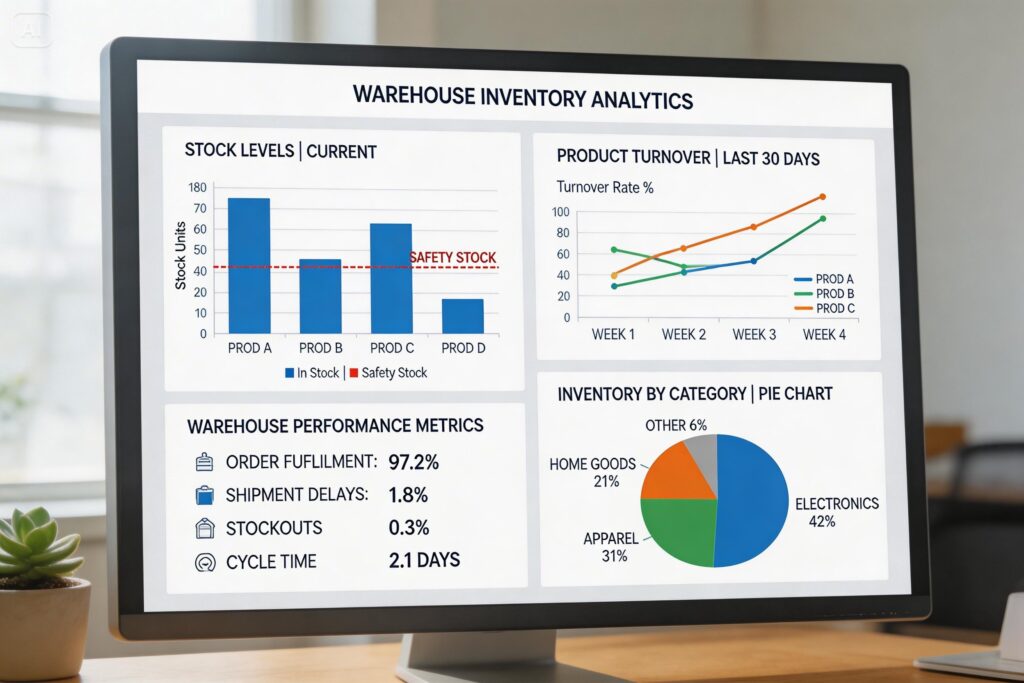
These reports support strategic decisions regarding procurement, pricing, and financial forecasting.
However, they typically reflect historical transactions rather than real-time warehouse conditions.
Integration Ecosystem
Businesses also examine how well the system integrates with surrounding operational tools.
Integration may involve:
E-commerce platforms
POS systems
procurement systems
external analytics tools

Yet integration complexity increases when inventory must synchronize across multiple channels simultaneously.
The integration challenge reflects a broader concept discussed in enterprise architecture literature: system coupling versus modular architecture. 【Resources Links】
Operational Limitations in High-Velocity Environments

Although SQL Inventory Management Software performs well within accounting contexts, its limitations become clearer in environments where inventory functions as an operational system.
Examples include:
Multi-warehouse distribution
high-volume order fulfillment
real-time barcode scanning
automated picking processes
These environments depend heavily on stock movement visibility across locations.
Warehouse Execution Complexity
Warehouse execution requires real-time task coordination:
pick path optimization
dynamic stock allocation
location-level tracking
scanning workflows
However, most SQL-centric systems track what happened, not what should happen next.
Consequently, warehouse staff often rely on spreadsheets, manual coordination, or external tools to manage operations.
Scalability Challenges
Scalability also becomes an architectural consideration.
When inventory transactions increase significantly, relational database systems must process:
more write operations
more synchronization events
more cross-system integrations
Although SQL databases scale well for structured data, they are not always optimized for operational event streaming or warehouse execution workflows.
Academic research into distributed systems such as the CAP theorem highlights the trade-offs between consistency, availability, and partition tolerance in scalable systems.
These trade-offs directly influence how inventory systems perform under operational pressure.
When Businesses Outgrow SQL Inventory Architecture
Most companies do not replace SQL Inventory Management Software immediately. Instead, operational requirements gradually reveal architectural gaps.
Typical growth stages include:
| Business Stage | Inventory System Role |
|---|---|
|
Early SME stage |
Basic stock tracking and accounting integration |
|
Growth stage |
Multi-channel inventory synchronization |
|
Operational scale stage |
Warehouse workflow automation |
|
Logistics maturity stage |
Real-time warehouse orchestration |
During the early stage, the benefits of SQL-based systems outweigh their limitations. However, as operations expand, businesses increasingly require deeper operational visibility.
In particular, the need for precise stock movement tracking across warehouse locations often signals that the system is approaching its limits.
The Emergence of Dedicated Warehouse Systems
As logistics complexity grows, many organizations evaluate warehouse management platforms designed specifically for operational environments.
Unlike accounting-centric systems, warehouse platforms prioritize:
real-time inventory visibility
task orchestration
scanning workflows
location-level tracking
These systems treat the warehouse as an operational network rather than a financial ledger.
Consequently, companies sometimes adopt warehouse management systems alongside their existing SQL Inventory Management Software, allowing each system to focus on its architectural strengths.
Within this evolving landscape, solutions such as PayRecon WMS represent one example of purpose-built warehouse management platforms designed to handle operational workflows that extend beyond the capabilities of traditional accounting-oriented inventory systems.
However, the decision to introduce such platforms usually reflects broader operational transformation rather than a simple software upgrade.
Strategic Considerations for System Evolution
Transitioning beyond SQL Inventory Management Software is rarely a purely technical decision. Instead, it reflects deeper shifts in operational maturity.
Businesses typically evaluate several strategic factors:
Operational Visibility
When companies require granular visibility into warehouse processes, reporting-centric systems may no longer provide sufficient insight.
Workflow Automation
Automation becomes critical when manual coordination begins to slow fulfillment processes.
Integration Complexity
As businesses connect more sales channels, synchronization requirements increase.
Organizational Maturity
More advanced systems also require operational discipline, standardized workflows, and trained staff. Therefore, system evolution often occurs alongside broader operational restructuring.
Conclusion

SQL Inventory Management Software remains a foundational component of many accounting-driven business systems. Its relational architecture provides strong financial visibility, reliable transaction tracking, and structured inventory reporting that supports financial governance.
However, the same architectural priorities that make these systems effective for accounting also introduce limitations when inventory becomes an operational system rather than simply a financial record.
As businesses grow, the importance of real-time stock movement visibility, workflow coordination, and warehouse execution gradually increases. At this stage, organizations begin reassessing whether their existing systems can support operational scale.
Rather than replacing financial systems entirely, many companies extend their technology stack by introducing specialized warehouse platforms that complement their accounting infrastructure. Solutions such as PayRecon WMS illustrate how warehouse-focused systems can support operational environments where logistics complexity exceeds the capabilities of traditional accounting-centric inventory tools.
Ultimately, the evolution beyond SQL Inventory Management Software reflects a broader shift in how organizations treat inventory: not only as a financial asset but also as a dynamic operational system that requires dedicated infrastructure to manage efficiently.