Inventory Movement Tracking Explained

Inventory movement tracking ensures precise stock control and comprehensive warehouse visibility, enabling businesses to manage operational complexity with strategic insight.
Introduction
In modern warehouse operations, inventory movement tracking is a critical component of operational efficiency and accuracy. Businesses across Southeast Asia, including SMEs in Malaysia, increasingly face complex supply chains where stock flows are frequent, multi-locational, and time-sensitive. Without accurate tracking, discrepancies in stock records propagate rapidly, undermining order fulfillment, forecasting reliability, and financial reporting.
Inventory movement tracking systems provide a structured approach to capturing real-time stock movements, creating traceable audit trails, and aligning physical stock with recorded data. For organizations evaluating digital transformation pathways, understanding the architectural, operational, and strategic implications of such systems is essential. Beyond mere automation, these systems influence workflow design, integration strategies, and long-term scalability. This article examines inventory movement tracking from a strategic perspective, analyzing trade-offs, structural strengths, limitations, and where such systems fit within SME and enterprise growth trajectories.
Why Inventory Movement Tracking Matters

Operational Visibility and Data Accuracy
At the core of inventory movement tracking lies operational visibility. 【Resources Links】 Businesses that implement tracking systems benefit from:
- Real-time location updates: Knowing where stock resides at any moment reduces the risk of mispicks or stockouts.
- Auditability: Each movement is logged, enabling compliance with internal controls and external audits.
- Error mitigation: Tracking reduces reliance on periodic stock counts, minimizing human error in manual processes.
However, systems vary in their ability to maintain consistent accuracy under high transaction volumes. Lightweight tracking solutions may excel for small inventories but struggle to handle multi-warehouse flows without latency or reconciliation issues.

Financial and Strategic Implications
Accurate inventory movement tracking directly affects financial performance. Businesses can:
- Optimize working capital by avoiding overstocking or understocking. 【Resources Links】
- Enhance forecasting accuracy, supporting procurement and production planning.
- Reduce loss due to shrinkage, misplacement, or spoilage.
Conversely, inadequate systems may generate misleading data, leading to operational decisions based on flawed insights. For SMEs scaling across regions, the risk amplifies exponentially.

Evaluating Inventory Movement Tracking Systems

Architectural Trade-offs
Inventory movement tracking architectures generally fall into two categories:
- Strengths: Simplifies reporting, consolidates audit trails, and facilitates cross-location visibility.
- Weaknesses: Can create single points of failure, may struggle with latency under heavy transaction loads.
- Strengths: Offers local autonomy, faster transaction processing, and resilience against partial system outages.
- Weaknesses: Requires robust synchronization mechanisms; complex reconciliation logic can increase operational overhead.
Deciding between these approaches depends on a business’s size, growth trajectory, and digital maturity. SMEs with a single warehouse may prioritize simplicity, whereas enterprises managing multiple facilities must weigh resilience and scalability.
Scalability and Integration
The ability to scale is critical. Inventory movement tracking must accommodate:
- Transaction volume growth – spikes in orders, seasonal demand, or multi-channel fulfillment.
- Multi-location inventory flows – including inter-warehouse transfers or drop-shipping operations.
- Integration with broader systems – ERP, order management, and logistics platforms.
Here, trade-offs often involve system complexity versus long-term flexibility. Highly integrated solutions may offer seamless data flow but require substantial implementation resources, whereas simpler, standalone systems enable rapid deployment but may create data silos. 【Resources Links】
Operational Workflow Considerations
Inventory movement tracking influences workflow design across warehousing functions:
- Receiving: Immediate logging of inbound stock ensures accountability and timely put-away.
- Picking and Packing: Real-time movement data reduces order fulfillment errors and enhances productivity.
- Cycle Counting and Reconciliation: Continuous tracking supports ongoing stock verification, reducing reliance on periodic full counts.
Each stage benefits from consistent data capture but introduces potential friction if the system imposes rigid operational procedures. Businesses must balance process control with workforce adaptability, especially when introducing tracking to SMEs with existing manual workflows.
Trade-offs in System Maturity
Lightweight vs. Purpose-Built Systems
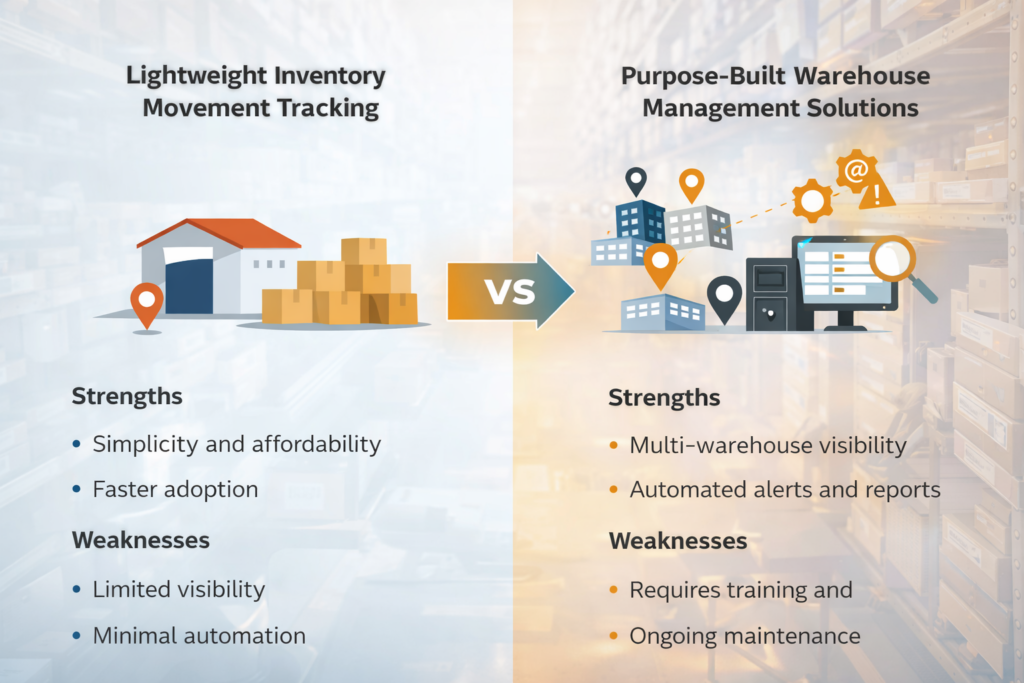
- Lightweight inventory movement tracking: Suitable for SMEs with low transaction volumes or single-location warehouses. Strengths include simplicity, affordability, and faster adoption. Weaknesses include limited visibility across multiple locations and minimal workflow automation.
- Purpose-built warehouse management solutions: Ideal for enterprises or growing SMEs, providing extensive workflow control, integration, and analytical capabilities. These systems support multi-warehouse visibility, automated alerts, and advanced reporting but require investment in training, configuration, and ongoing maintenance.
Deciding when to upgrade involves assessing operational complexity, transaction volume, and long-term digital maturity rather than simply system features. 【Resources Links】
Contextualizing in Southeast Asia SMEs
In Malaysia and broader Southeast Asia, many SMEs encounter rapid scaling challenges:
- Expansion into e-commerce channels increases SKU variety and turnover rates.
- Multi-channel sales require synchronized stock levels across marketplaces, physical stores, and warehouses.
- Labor variability and operational cost pressures necessitate systems that reduce manual intervention while maintaining accuracy.
For these SMEs, inventory movement tracking systems are not only operational tools but also strategic instruments supporting growth decisions. Systems must therefore deliver accurate insights, enable process standardization, and accommodate expansion without undermining agility.
Strategic Pathways: Integration and Long-Term Evolution
As SMEs evolve, adopting robust warehouse management platforms becomes a strategic consideration. Platforms such as PayRecon WMS exemplify purpose-built solutions that integrate inventory movement tracking into broader operational management frameworks. They allow businesses to:
- Synchronize multi-location stock in real time.
- Implement workflow automation across receiving, picking, packing, and dispatch.
- Gain analytical insights for long-term inventory optimization.
However, such platforms are best approached as part of a staged digital maturity plan. Businesses typically progress from basic tracking systems to integrated warehouse management platforms when operational complexity, transaction volume, or multi-location flows make lightweight solutions inadequate. PayRecon WMS represents one pathway among several, offering SMEs a model for structured, scalable growth rather than a one-size-fits-all solution.
Conclusion
Inventory movement tracking is a foundational element of modern warehouse management. Strategically, it ensures data accuracy, operational visibility, and informed decision-making, which are critical for SMEs and enterprises alike. The choice of system requires evaluating architectural trade-offs, integration complexity, scalability potential, and workflow impact.
Businesses often begin with lightweight systems, suitable for low transaction volumes and single-location operations, but they eventually outgrow these solutions as complexity increases. At this juncture, purpose-built warehouse management platforms such as PayRecon WMS provide a structured pathway for integrating inventory movement tracking into broader operational and strategic frameworks. By aligning system choice with operational maturity, organizations can balance efficiency, visibility, and scalability while laying the foundation for long-term growth.