Best Warehouse Management System for Growing Retail
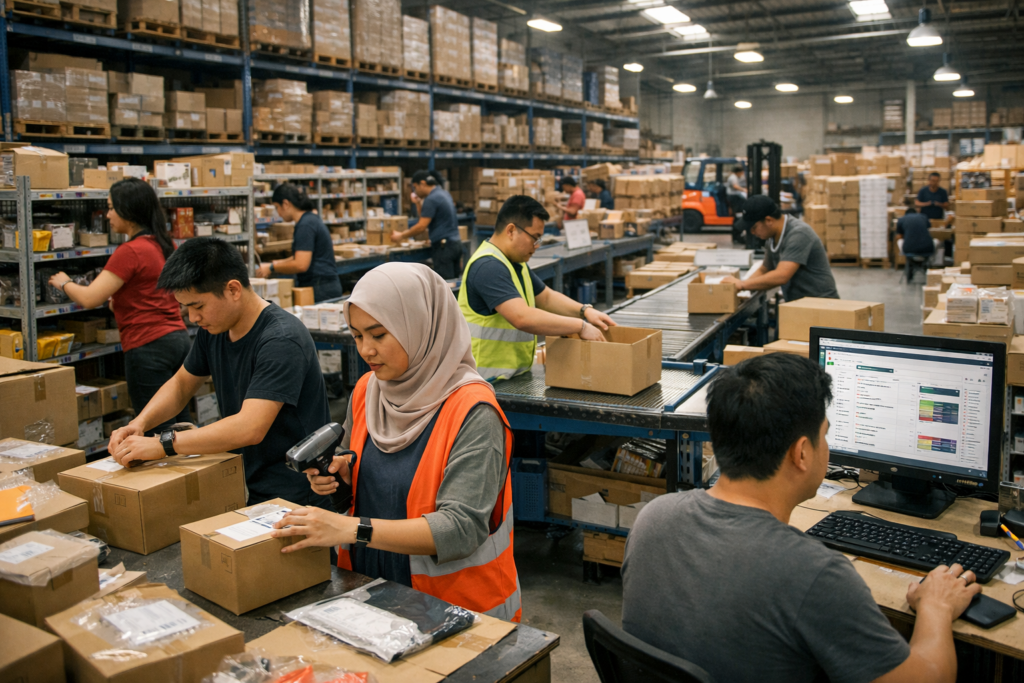
The best warehouse management system is no longer defined by features alone. Retailers scaling across Shopee, Lazada, and TikTok Shop often discover that system choice creates new bottlenecks instead of solving them. This article explains how to evaluate the best warehouse management system beyond surface-level functionality.
Introduction
Retail growth in Southeast Asia has shifted from linear expansion to operational complexity. Multi-channel selling, faster delivery expectations, and rising SKU counts have transformed warehouses into strategic control centers. Yet many businesses still approach system selection as a feature comparison exercise.
This creates a dangerous expectation gap.
The assumption is simple: the best warehouse management system will automatically improve efficiency. In reality, system performance depends on alignment with operational structure, data flow, and business model maturity.
Beginner-level advice often lists features such as barcode scanning or inventory tracking. These are baseline requirements, not differentiators. The real question is structural: how well does the system sustain control as complexity increases?
This article applies a strategic decision framework to evaluate that question.
The Best Warehouse Management System Is a Fit, Not a Ranking
There is no universal “best” system across all retail contexts. The concept itself is misleading when treated as a static ranking.
Fit determines performance.
A system that works for a single-channel Shopify store may fail in a multi-marketplace environment. Similarly, a solution designed for enterprise logistics may overwhelm a mid-sized retailer with unnecessary complexity.
The evaluation must begin with operational reality.
Retailers in Malaysia often operate across fragmented platforms with varying integration maturity. This creates unique constraints. The best warehouse management system must align with these constraints rather than assume ideal conditions.
A mismatch creates friction, not efficiency.
Operational Scale Changes What “Best” Actually Means
System requirements evolve as businesses scale. What feels sufficient at one stage becomes a limitation at the next.
Scale redefines priorities.
At early stages, visibility and basic control are enough. As order volume increases, execution speed and synchronization become critical. At higher complexity levels, predictive control and automation start to matter.
The system must evolve with the business.
Many retailers delay system upgrades until problems become severe. By then, operational debt has already accumulated. Transitioning becomes more disruptive and costly.
Late adoption increases risk.
Integration Depth Determines Real System Value
Most warehouse systems claim integration capabilities. However, the depth and reliability of these integrations vary significantly.
Superficial integration is common.
A system may connect to marketplaces but fail to synchronize data in real time. Delays in inventory updates can lead to overselling. Inconsistent order status updates create confusion across teams.
This is where hidden inefficiencies emerge.
The best warehouse management system is defined by how seamlessly it connects operational touchpoints. This includes marketplaces, accounting software, logistics partners, and internal systems.
Data flow is the real infrastructure.
Without strong integration, even advanced features lose effectiveness. The system becomes another isolated layer rather than a control center.
Execution Control Matters More Than Feature Lists
Feature comparisons dominate most buying decisions. However, features alone do not guarantee operational control.
Execution determines outcomes.
A system may offer advanced picking strategies, but if workflows are not enforced consistently, errors persist. Barcode scanning may exist, but bypassing it during peak periods undermines control.
The gap is behavioral, not technical.
The best warehouse management system enforces discipline through design. It reduces reliance on manual decisions and standardizes execution across teams.
Consistency creates control.
Systems that rely heavily on user compliance without enforcement mechanisms often fail under pressure. Real-world operations require systems that guide behavior, not just record it.
Cost Efficiency Is Shaped by Structure, Not Pricing
Many businesses evaluate systems based on subscription costs. This approach overlooks the broader cost structure associated with warehouse operations.
Direct cost is only one layer.
Indirect costs include inefficiencies, errors, delays, and manual interventions. A cheaper system may appear cost-effective initially but create higher operational costs over time.
Hidden costs accumulate silently.
The best warehouse management system reduces total operational cost, not just software expenses. It minimizes errors, improves throughput, and enhances decision accuracy.
Efficiency compounds over time.
Retailers should evaluate cost in terms of impact on margins, not just monthly fees. This requires a longer-term perspective.
System Rigidity vs Flexibility: A Strategic Trade-Off
Warehouse systems vary in how rigid or flexible their structures are. This creates an important trade-off.
Flexibility enables adaptation.
Rigid systems enforce strict processes, which can improve consistency but reduce adaptability. Flexible systems allow customization but may introduce inconsistency if not managed carefully.
There is no perfect balance.
Retailers must decide based on their operational maturity. Early-stage businesses may benefit from flexibility. More complex operations often require structured control.
Structure supports scale.
Choosing incorrectly leads to friction. Too much rigidity limits growth experimentation. Too much flexibility weakens control.
When Complexity Demands Purpose-Built Systems
At a certain scale, generic tools struggle to handle operational complexity. This is where purpose-built warehouse management systems become relevant.
Complexity creates new requirements.
These include real-time synchronization, multi-location inventory control, advanced picking logic, and integration with diverse platforms. Generic systems often lack the depth needed to manage these effectively.
Specialization becomes necessary.
Solutions such as PayRecon WMS represent one category of purpose-built systems designed for multi-channel retail environments. They focus on aligning operational workflows with system logic, rather than simply adding features.
However, they are not universal solutions.
Businesses must evaluate whether their operational complexity justifies this level of system investment. Premature adoption can create unnecessary overhead.
Timing determines value.
Conclusion: The Best System Is Defined by Structural Alignment
The best warehouse management system is not the most advanced or widely marketed option. It is the one that aligns with operational structure, scale, and strategic direction.
Fit outweighs features.
Retailers who prioritize alignment over hype are more likely to achieve sustainable efficiency. Those who chase features without structural clarity often face recurring operational issues.
The opportunity is scalable but conditional.
For growing retail businesses in Malaysia and Southeast Asia, the priority should be clear. Understand operational complexity, define control requirements, and evaluate systems based on structural fit.
Then scale with intention.
Because in warehouse operations, the best system is not chosen once. It evolves with the business.