Warehouse Inventory System: How to Prevent Stockouts and Overselling

A strategic analysis of how a warehouse inventory system improves stock accuracy, synchronizes multichannel inventory, and helps businesses reduce stockouts and overselling risks as operational complexity grows.
Introduction
Inventory accuracy has become a defining operational capability in modern commerce. A warehouse inventory system is no longer merely a back-office tool used to track quantities; instead, it functions as a core infrastructure layer supporting order fulfillment, supply chain coordination, and multichannel synchronization. As e-commerce platforms, marketplaces, and retail channels converge, the consequences of stock discrepancies become increasingly severe. Overselling can trigger fulfillment delays and reputational damage, while stockouts translate directly into lost revenue and reduced customer trust.
Industry research consistently highlights the structural impact of inventory accuracy. According to a study published by the MIT Center for Transportation & Logistics, poor inventory visibility remains one of the leading causes of operational inefficiency in distribution networks (https://ctl.mit.edu). Consequently, businesses evaluating a warehouse inventory system must look beyond feature lists and instead analyze architectural design, integration capability, scalability, and long-term operational alignment.
This article examines how companies strategically evaluate such systems, focusing on trade-offs in architecture, workflow governance, and digital maturity. Rather than presenting implementation instructions, the discussion focuses on structural considerations that influence whether inventory systems can effectively prevent stockouts and overselling.
Understanding the Strategic Role of a Warehouse Inventory System
At a foundational level, a warehouse inventory system provides centralized visibility into stock availability and movement. However, in contemporary supply chains, its function extends far beyond simple quantity tracking.
Modern inventory infrastructures support:
Real-time stock visibility across multiple warehouses or fulfillment centers
Synchronization between e-commerce platforms, ERP systems, and POS networks
Continuous stock tracking across inbound, storage, picking, and outbound processes
Analytical stock reporting used for forecasting and demand planning
These capabilities collectively enable organizations to transition from reactive inventory adjustments toward predictive operational control.
For instance, many digital commerce platforms emphasize the importance of synchronized inventory to prevent overselling across multiple marketplaces. Shopify’s operational guidance highlights that businesses operating across several sales channels require centralized inventory control to avoid conflicting stock levels between storefronts and marketplaces (https://www.shopify.com/blog/inventory-management).
Therefore, the strategic value of a warehouse inventory system lies in its ability to function as a coordination layer between operational workflows and commercial demand signals.
Architectural Trade-offs in Warehouse Inventory System Design
Businesses evaluating a warehouse inventory system frequently encounter structural trade-offs related to system architecture. These design choices influence both operational reliability and long-term scalability.
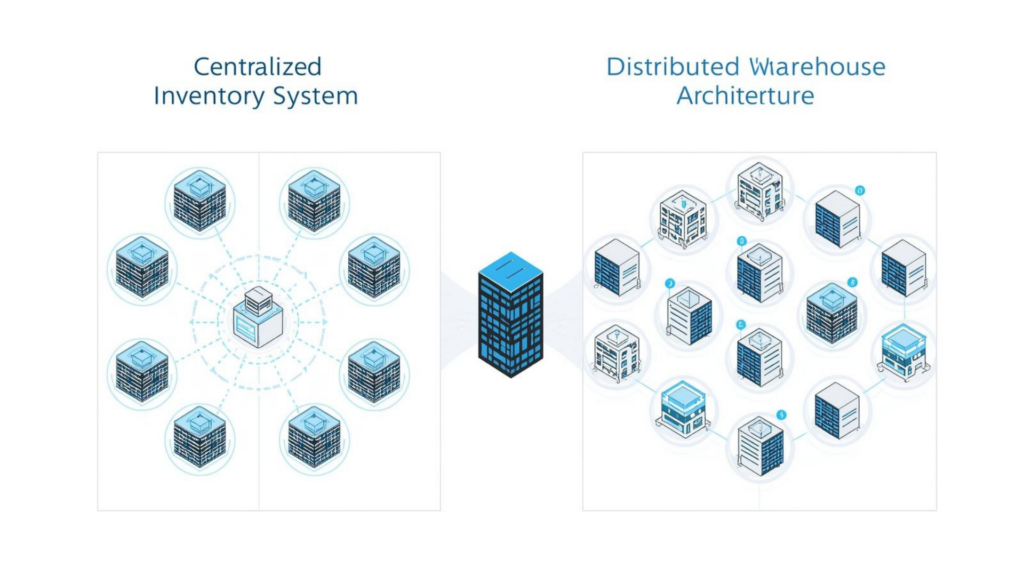
1. Centralized vs Distributed Data Architecture
Centralized inventory architecture
Maintains a single source of truth for all stock records
Reduces synchronization conflicts between warehouses
Simplifies stock reporting and analytics
However, centralized systems may experience performance constraints when large distribution networks operate across different geographical regions.
Distributed architecture
Allows individual warehouses to process operations locally
Reduces latency for scanning and picking activities
Improves resilience during network disruptions
Nevertheless, distributed systems introduce synchronization complexity. Without strong reconciliation logic, inconsistencies may appear across sales channels, increasing the risk of overselling.
Research from Gartner’s supply chain technology analysis emphasizes that distributed inventory environments require strong synchronization mechanisms to maintain operational visibility across networks (https://www.gartner.com/en/supply-chain).

2. Cloud vs On-Premise Deployment Models
Deployment architecture significantly affects how a warehouse inventory system scales.
|
Deployment Model
|
Strategic Strength
|
Structural Limitation
|
|---|---|---|
|
Cloud-based systems
|
Elastic scalability and easier integration with e-commerce platforms
|
Dependence on internet connectivity and vendor infrastructure
|
|
On-premise systems
|
Greater control over infrastructure and data security
|
Higher upfront capital investment and slower upgrade cycles
|
Cloud architectures increasingly dominate modern inventory ecosystems because they allow businesses to synchronize stock data across geographically distributed sales channels. Major cloud providers outline how distributed applications maintain data consistency across services, such as the architectural frameworks described by Amazon Web Services (https://aws.amazon.com/architecture).
However, the choice between deployment models ultimately depends on operational maturity, regulatory considerations, and internal IT capabilities.
Operational Visibility and Data Synchronization
Preventing stockouts and overselling depends heavily on the visibility provided by a warehouse inventory system. Operational transparency ensures that inventory information reflects real-world warehouse conditions rather than delayed database updates.
Three visibility dimensions are particularly relevant:
Continuous stock tracking across warehouse processes—receiving, storage, picking, packing, and shipping—ensures that inventory status reflects physical operations. Without such process-level visibility, discrepancies accumulate quickly.
Multichannel commerce introduces synchronization challenges. A product listed on multiple marketplaces must reflect identical stock quantities across all channels.
Without a coordinated warehouse inventory system:
Marketplace A may show stock availability
Marketplace B may process a simultaneous order
Both transactions reduce the same inventory pool
Such conflicts represent a common cause of overselling in digital commerce environments.
Advanced stock reporting transforms operational data into strategic insight. Businesses can analyze:
SKU turnover velocity
seasonal demand fluctuations
replenishment lead time variability
Studies published by McKinsey & Company highlight that companies with advanced supply chain analytics significantly outperform peers in fulfillment speed and inventory efficiency.
Workflow Governance and Process Control
A warehouse inventory system also functions as a workflow orchestration framework. Rather than merely recording stock quantities, it coordinates operational tasks within warehouse environments.
Typical workflow layers include:




The effectiveness of these workflows depends on configurable operational logic.
For example, organizations must determine whether order allocation should prioritize:
proximity to the customer
warehouse capacity
inventory aging
Such decisions influence both fulfillment efficiency and inventory turnover.
Additionally, the system must balance automation and human oversight. While automated workflows reduce manual errors, excessive automation may obscure anomalies until they escalate into operational disruptions.
Inventory System Maturity Across Business Growth Stages

The relevance of a warehouse inventory system evolves as organizations progress through different operational stages.
Early-stage commerce operations
Smaller businesses often rely on lightweight inventory tools embedded within e-commerce platforms. These solutions provide basic inventory control and stock visibility but typically lack advanced warehouse workflow capabilities.
Growth-stage SMEs
As order volume increases, businesses begin operating multiple warehouses or integrating with third-party logistics providers. At this stage, inventory synchronization becomes more complex, and overselling risks increase significantly.
Mature distribution networks
Enterprises managing regional or international distribution networks require advanced systems capable of orchestrating multi-location operations, supplier coordination, and demand forecasting.
Research from Deloitte’s supply chain transformation studies shows that organizations often transition through several technology layers as operational complexity increases (https://www2.deloitte.com/insights).
A warehouse inventory system must therefore align not only with current operational requirements but also with future scalability expectations.
Strategic Evolution Toward Advanced Warehouse Management Platforms

As organizations expand their logistics networks, traditional inventory solutions may struggle to support increasing operational complexity. Businesses frequently reach a stage where warehouse processes require deeper orchestration than simple inventory databases can provide.
At this point, purpose-built warehouse management platforms become relevant. Solutions such as PayRecon WMS represent a category of systems designed to manage warehouse workflows, multichannel synchronization, and operational analytics within a unified infrastructure.
Within the broader technology ecosystem, these platforms typically offer:
advanced warehouse workflow orchestration
automated order routing across fulfillment locations
synchronized inventory updates across sales channels
detailed operational analytics supporting decision-making
Importantly, the transition to such systems usually reflects operational evolution rather than technological preference. Businesses adopt them when inventory management requirements exceed the capabilities of simpler tools.
Conclusion
A warehouse inventory system plays a critical role in preventing stockouts and overselling by providing the infrastructure necessary for accurate inventory visibility, synchronized data flows, and coordinated warehouse workflows. However, selecting the right system requires careful evaluation of architectural design, integration capability, and long-term scalability rather than superficial feature comparisons.
Businesses often begin with lightweight inventory tools during early growth phases. As operational complexity increases—through multichannel commerce, multiple warehouses, and higher transaction volumes—these tools may become insufficient. At that point, organizations typically explore more advanced warehouse management platforms capable of orchestrating workflows and maintaining real-time synchronization across systems.
Solutions such as PayRecon WMS illustrate how purpose-built warehouse management platforms fit within this evolution pathway. Rather than replacing existing systems arbitrarily, they represent a natural progression when businesses require deeper operational control and more reliable inventory visibility.
Ultimately, the strategic question is not whether a warehouse inventory system is necessary, but whether the chosen system aligns with the organization’s operational maturity and future growth trajectory.