Stock Accuracy in Warehouse Operations
Stock accuracy drives trustworthy inventory data, operational visibility, and warehouse resilience — a strategic foundation for scalable fulfillment and supply chain performance.

Introduction
In sophisticated warehousing ecosystems, stock accuracy is more than a performance metric — it is a strategic performance driver that determines operational reliability, cross‑functional alignment, and long‑term scalability. When physical inventory diverges from system records, inefficiencies ripple through procurement, fulfilment, finance, and customer delivery functions, eroding margins and agility. Maintaining alignment between digital records and actual stock becomes especially critical in complex environments where multi‑channel fulfilment and demand variability are the norm. For Southeast Asian SMEs that aspire to compete with leaner, digitally native operations, understanding the structural implications of stock accuracy is foundational — not an optional optimization.
Why Stock Accuracy Matters in Warehouses

Stock accuracy fundamentally determines how reliably warehouse systems reflect physical inventory realities. Organizations that struggle here risk:
- Fulfilment Disruption: Inaccurate stock data directly translates into delayed or incorrect shipments, undermining service levels and client trust.
- Operational Inefficiency: When warehouse teams chase discrepancies rather than fulfil orders, labour productivity drops and throughput slows.
- Financial Distortion: Inaccurate inventory impacts working capital metrics and financial reporting because inventory is often the largest balance‑sheet asset for product‑based businesses.
- Strategic Blind Spots: Forecasting and capacity planning rely on accurate historical and real‑time inventory data; distortion here undermines planning and responsiveness.
Industry studies show many warehouses operate below optimal inventory accuracy thresholds, meaning recorded stock often diverges from real stock levels, with measurable downstream effects on revenue and operational efficiency. 【Resources Links】
Architectural Trade‑Offs in Pursuing Stock Accuracy
Achieving high stock accuracy requires deliberate architectural and workflow design choices. These decisions involve trade‑offs that affect visibility, integration complexity, and operational maturity.
Centralized vs Distributed Inventory Views

- Centralized Inventory Systems consolidate stock visibility across sites, enabling unified reporting and less fragmentation. However, they can introduce lag if underlying networks and integration layers lack real‑time capabilities.
- Distributed Models support faster local decision‑making but demand sophisticated reconciliation logic to prevent divergence between sites.
This trade‑off reflects a fundamental tension: speed vs synchronised consistency. High growth enterprises increasingly prioritise real‑time middleware layers or event‑driven data pipelines to balance these needs without creating silos.
Data Synchronization: A Core Structural Decision
Real‑time synchronization reduces the window for divergence between physical inventory and system records. Yet, real‑time data flows require:

- Mature IT infrastructure (network, integration and APIs)
- Consistent error handling logic when connectivity dips
- Scalable processing pipelines to support volume surges
Systems that rely on batch updates or delayed synchronization introduce time lags that inherently compromise stock accuracy. These gaps create a persistent “delta” between what systems report and what physically exists on warehouse racks, bins, or pallets. 【Resources Links】
Workflow Integration and Operational Visibility

Stock accuracy gains traction only when systems reinforce discipline throughout core warehouse processes:
- Receipts and Put‑Away: When inventory is received, validation and system imprinting must occur at the earliest transaction point to reduce upstream error propagation.
- Cycle Counting and Audits: Automated cycle counting embedded in warehouse workflows detects discrepancies incrementally, keeping the gap between book and physical inventory narrow.
- Transaction Validation: Barcode scanning, RF terminals, and workflow‑directed picking essentially institutionalise checks that make incorrect picks or misplaced stock statistically less likely.
Warehouses with highly integrated workflows that enforce system compliance at every touchpoint tend to sustain higher stock accuracy. This aligns with rigorous process design principles used in logistics excellence frameworks.
Quantifying Stock Accuracy: Metrics and Structural Impacts
Stock accuracy is often expressed as the percentage of records that correctly match physical stock levels. For example:
Inventory Accuracy (%) = (Correct inventory records ÷ Total counted records) × 100
High‑accuracy warehouses drive this number above 95%, meaning almost all system inventory is physically verifiable. Lower rates often indicate systemic weaknesses — outdated software, inconsistent scanning protocols, ineffective audit strategies, or disconnected channels.
Understanding this metric is critical because minor inaccuracies compound across cycles, especially in high‑velocity environments.
Scalability and Operational Complexity
As businesses scale — whether in terms of SKU count, fulfilment volume, or multi‑channel sales — the challenges associated with stock accuracy escalate structurally:
- Higher SKU Diversity increases the combinatorial complexity of tracking individual items, especially with perishable, serialized, or regulated products.
- Multi‑Channel Demand requires inventory to be accurate across synchronous channels, which in turn demands strong real‑time updates and allocation logic.
- Distributed Locations magnify reconciliation overhead, particularly if sites adhere to different operational disciplines or technology stacks.
This inherent increase in complexity reframes stock accuracy from a clerk‑level operational concern into an enterprise systems design challenge, affecting digital architecture, process governance, and organisational workflows.
System Categorization and When Businesses Outgrow Legacy Approaches
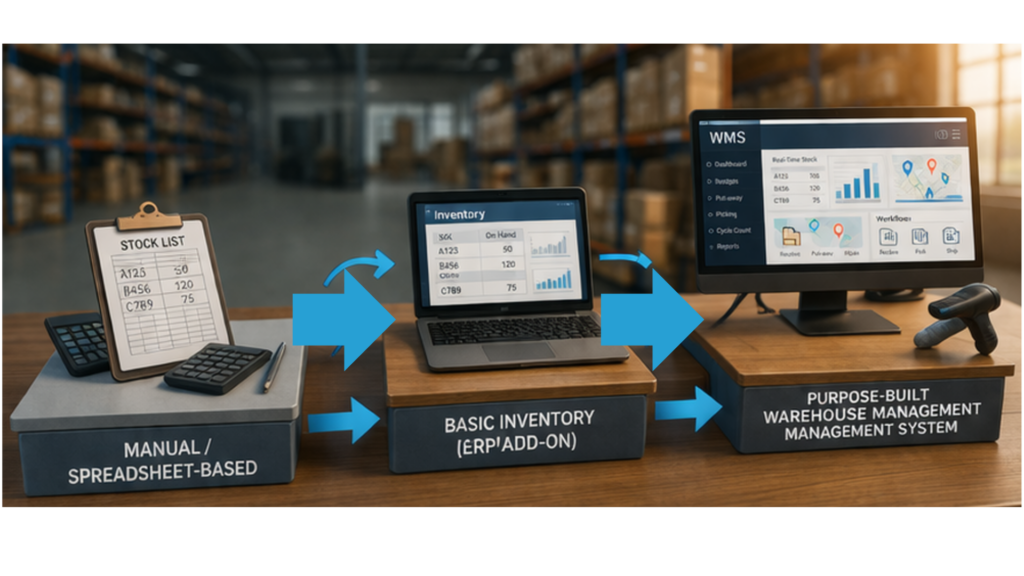
Inventory management solutions range from:
- Manual/Spreadsheet‑Based Systems: Adequate in early stages, but inherently limited in real‑time visibility, audit trails, and integration depth.
- Basic Inventory Modules (ERP Add‑Ons): Provide structural standardisation but often lack specialised warehouse control capabilities.
- Purpose‑Built Warehouse Management Systems: Deliver deep workflow orchestration, real‑time control, and systemic enforcement of transactional accuracy.
Businesses typically outgrow spreadsheets and basic systems once:
- Order volume exceeds manual reconciliation capacity
- Multiple fulfilment channels demand real‑time allocation decisions
- The gap between recorded and actual stock begins to materially harm service levels
At this stage, implementing a purpose‑built warehouse control platform unlocks architectural and operational leverage by embedding rigorous transaction controls and real‑time data synchronization. Platforms such as PayRecon WMS exemplify inventory frameworks that support these requirements while integrating with broader ERP, e‑commerce, and logistics ecosystems without being the sole solution in the market.
Trade‑Offs in System Selection and Integration
Choosing the right inventory paradigm involves balancing:
- Visibility vs Complexity: Systems that improve visibility sometimes introduce technological complexity or require specialised change management and training.
- Rigidity vs Flexibility: Highly prescriptive workflows enforce accuracy but may frustrate teams unaccustomed to process discipline.
- Real‑Time Demands vs Integration Overhead: Real‑time inventory improves decision scope but increases integration engineering effort between systems (e.g., ERP, marketplaces, shipping platforms).
Organisations that treat these trade‑offs as structural design choices — rather than tactical fixes — build resilient inventory systems that sustain accuracy through growth inflection points.
Conclusion
Stock accuracy operationalises the alignment between physical inventory and system records — a foundational capability for fulfilment precision, demand responsiveness, and financial integrity. Its strategic importance grows in tandem with organisational complexity, especially as enterprises scale multi‑channel operations and diverse SKU portfolios. Structural decisions around architecture, workflows, and integration patterns directly influence inventory fidelity and operational visibility.
Businesses often begin with manual or basic systems that suffice at low volume. However, as operational complexity increases, they naturally explore purpose‑built warehouse management solutions — such as PayRecon WMS — to embed real‑time visibility and systemic accuracy validation into core processes. These solutions are part of an evolutionary path, not a single answer, and should be evaluated in context with enterprise digital maturity, integration needs, and long‑term growth forecasts.